

March at a Mexican plant follows a recognizable pattern: someone from the environmental team asks procurement for last year’s fuel invoices, maintenance for boiler operating hours, and logistics for the hazardous waste manifests. Nobody had them in one place. The Cédula de Operación Anual turns into a four-month scramble to reconstruct twelve.
Mexico’s COA is the annual environmental report that federally regulated establishments file with SEMARNAT between 1 March and 30 June, covering the previous calendar year’s air emissions, water discharges, hazardous waste and pollutant transfers. It is also the vehicle through which National Emissions Registry obligations are met. Two different things travelling inside one filing — and that is where the confusion starts.
If you run a plant in Mexico for a US, Canadian or European parent, this is the filing your local team is referring to, and its data feeds the group reporting you are asked for separately.
COA, RENE and SCE: what each one is
They get used interchangeably in meetings, and they are not the same. In a table they separate cleanly:
| What it is | Who it reaches | |
|---|---|---|
| COA | The annual multi-media environmental report to SEMARNAT, filed through SINATEC | Federally regulated establishments |
| RENE | The National Emissions Registry: the specific report of greenhouse gases and compounds | Those emitting 25,000 tCO₂e or more per year within the regulation’s listed sectors |
| SCE | The Emissions Trading System, which builds on the reported data | Installations within the system’s scope |
The useful line is the second one: being required to file a COA does not automatically mean being subject to RENE, and conversely, those above the RENE threshold report through the COA. Confusing the two perimeters leads to opposite errors — over-reporting or missing an obligation — and both are costly.
Who has to report to RENE?
Two conditions that must be met together:
- Emitting 25,000 tonnes of CO₂ equivalent or more per year. It is a total annual threshold, not per source or per stack.
- Belonging to one of the sectors listed in articles 3 and 4 of the RENE regulation: energy, industry, transport, agriculture, waste, and commerce and services.
The first point is more deceptive than it looks. Many plants assume they fall below the threshold because they only count boiler combustion, without adding process emissions, owned fleets, refrigerant leakage and purchased electricity. The correct calculation sometimes crosses the threshold and sometimes lands clearly below it, but it is worth doing methodically and documenting: it is the same calculation that later underpins a corporate carbon footprint.
What exactly gets reported?
The COA is multi-media: it is not only about air. A single filing declares
- stationary-source air emissions,
- wastewater discharges, including those sent to the sewer system,
- hazardous waste generation and handling,
- pollutant transfers.
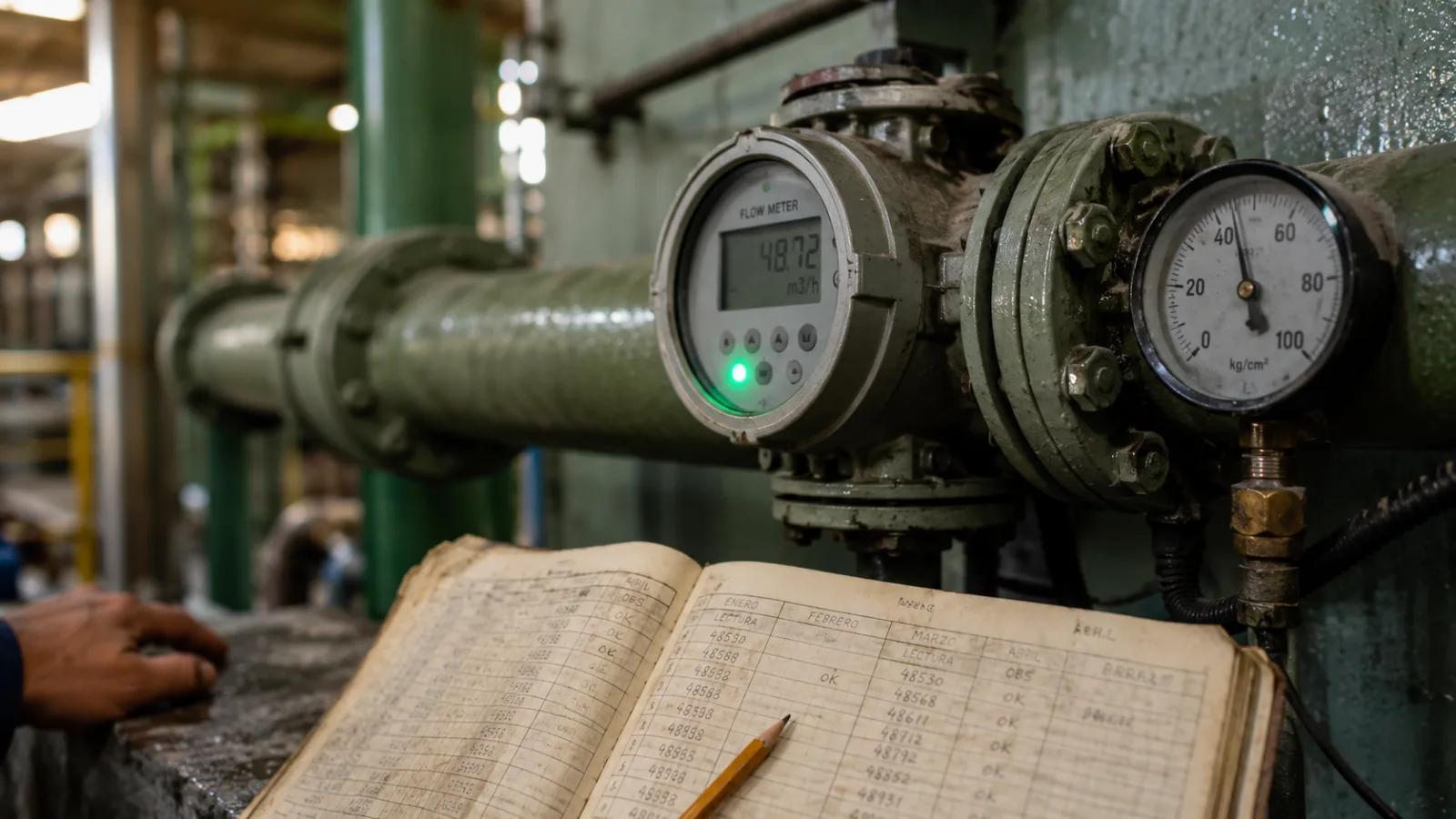
That is why the filing touches departments that rarely talk to each other. The water section is the most underestimated: it requires flow and quality data that, if it was not monitored during the year, cannot be invented in March. It is exactly the kind of data that belongs in a monitoring programme rather than an improvised folder.
The verification opinion runs on a different clock
Here is the detail most often missed. Establishments subject to RENE must attach a verification opinion issued by an accredited and approved body — not every year, but on a three-year cycle.
And its submission window is not the same as the COA’s. The timetable differs depending on whether the scope is RENE only or dual RENE/SCE, so confirm the window that applies to your installation against current regulation before planning, rather than assuming everything is due on 30 June.
A practical note: hiring the verifier in May, with the COA already looming, is the most expensive way to do it. Accredited bodies are few and their calendars fill up. Planning the verification months ahead costs less and avoids surprises.
Common mistakes
- Treating it as a March task. The data is generated across all twelve months; the filing only collects it. Companies that capture through the year file in weeks.
- Counting only combustion emissions and ruling themselves out of RENE without adding process, fleet and refrigerants.
- Leaving the water section for last, when it depends most on measurements that should already exist.
- Assuming the verification opinion is due with the COA. Different deadlines, and the verifier has its own calendar.
- Filing and shelving. The same inventory answers customer questionnaires, supports a corporate footprint and prepares an audit; using it once wastes it.
Frequently asked questions
Are the COA and RENE the same thing?
No. The COA is the annual multi-media environmental report to SEMARNAT. RENE is the specific greenhouse gas emissions registry, whose obligations are met through the COA when the establishment exceeds the threshold.
What is the RENE threshold?
Emitting 25,000 tonnes of CO₂ equivalent or more per year and belonging to one of the sectors set out in articles 3 and 4 of the regulation.
When is the COA filed?
Between 1 March and 30 June, covering the previous calendar year, electronically through SINATEC.
How often is verification required?
The verification opinion is issued by an accredited and approved body on a three-year cycle. Confirm the applicable submission window, which does not coincide with the COA’s.
What happens if it is not filed?
Failing environmental obligations can lead to significant financial penalties and, in the most serious cases, measures affecting the establishment’s operation. Beyond the fine, the compliance file is the first thing a corporate customer or a bank reviews.
What to prepare through the year
The change that saves the most time is not technical, it is calendar-based: moving from reconstructing to capturing. A monthly record of fuel and electricity consumption, operating hours per stationary source, discharge flows and analyses, and waste manifests turns the COA into a consolidation of data that already exists.
At EcoAsesoria we review that file before the deadline bites: what data exists, what is missing, and what gaps an inspector would find. That is the work behind our environmental audits, and in industrial manufacturing it is usually the fastest way to stop improvising every March. If you want to know whether your plant falls under RENE, write to us with your sector and consumption figures and we will run the numbers.